
A porcelain plate can be surprisingly easy to overlook.
It may sit unnoticed in a China cabinet for decades, pass through generations, or turn up for a few dollars at an antique store. It might have belonged to someone’s grandmother or been part of a set that has long since been broken up. Most of the time, we don’t think much about what makes an object valuable until something happens to it.
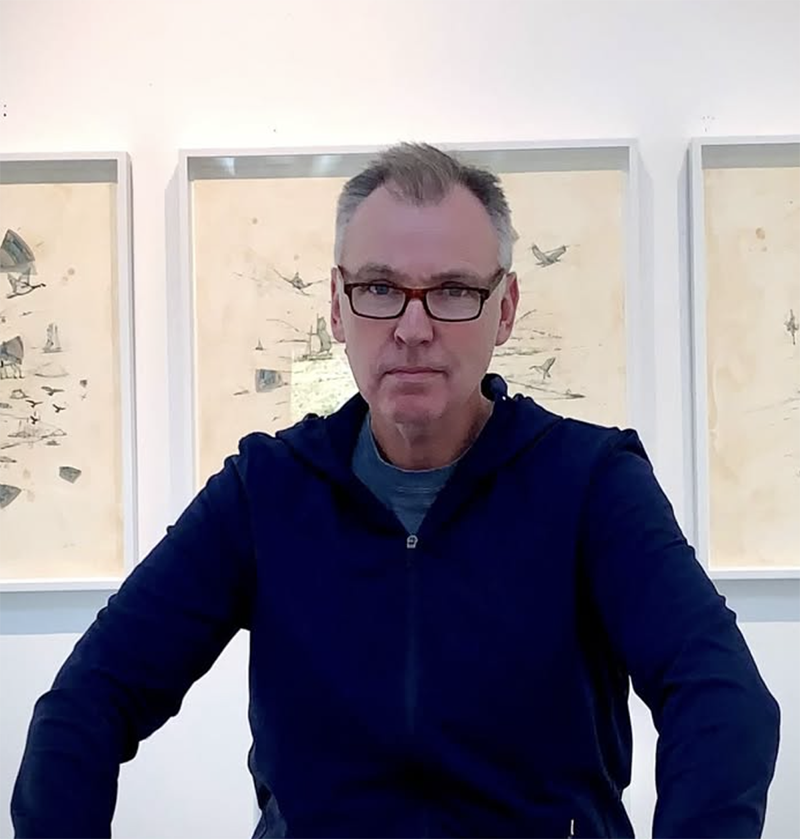
For artist Rob Strati, the story begins when his wife dropped a porcelain plate belonging to her mother. Rather than discard the pieces, Rob kept a large fragment on the kitchen island and began looking at it more closely. What he had originally seen as a blue and white pattern turned out to be figures and birds within a landscape, so he started drawing beyond it with ink. Since then, ships, landscapes, animals, figures and imagined worlds emerged from objects that had once seemed destined for the trash.
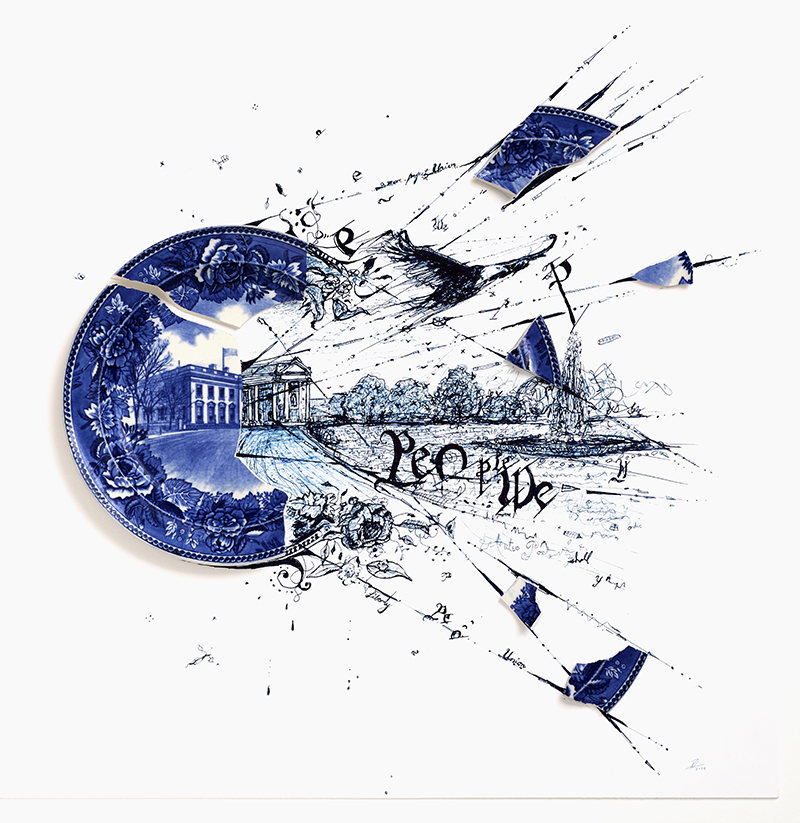
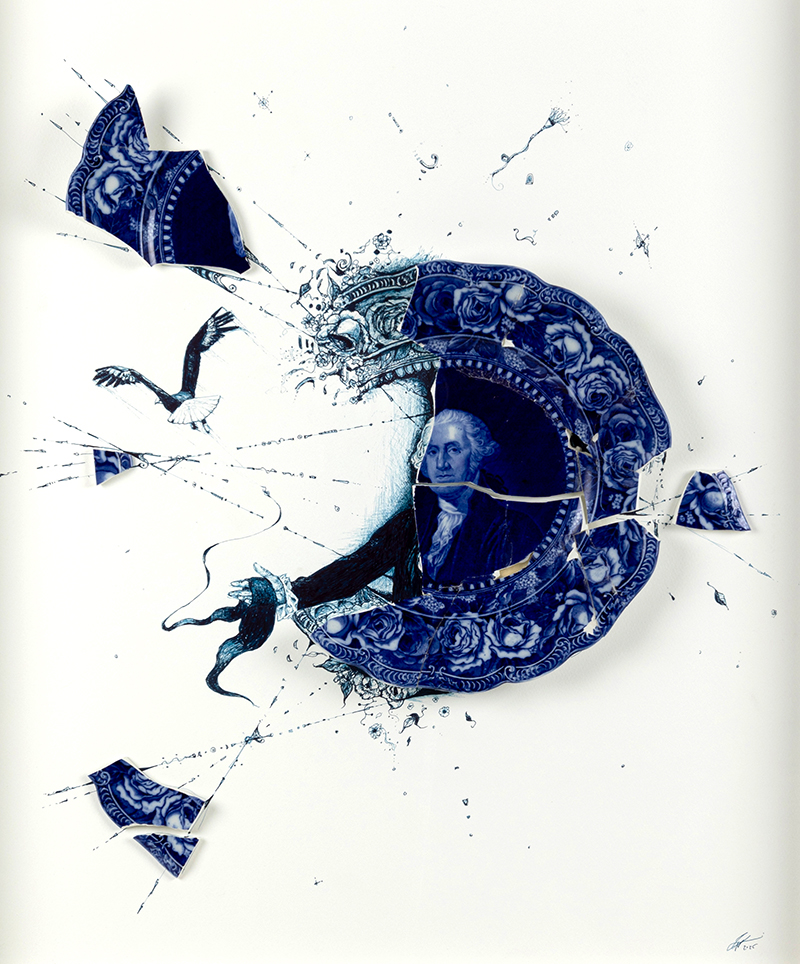
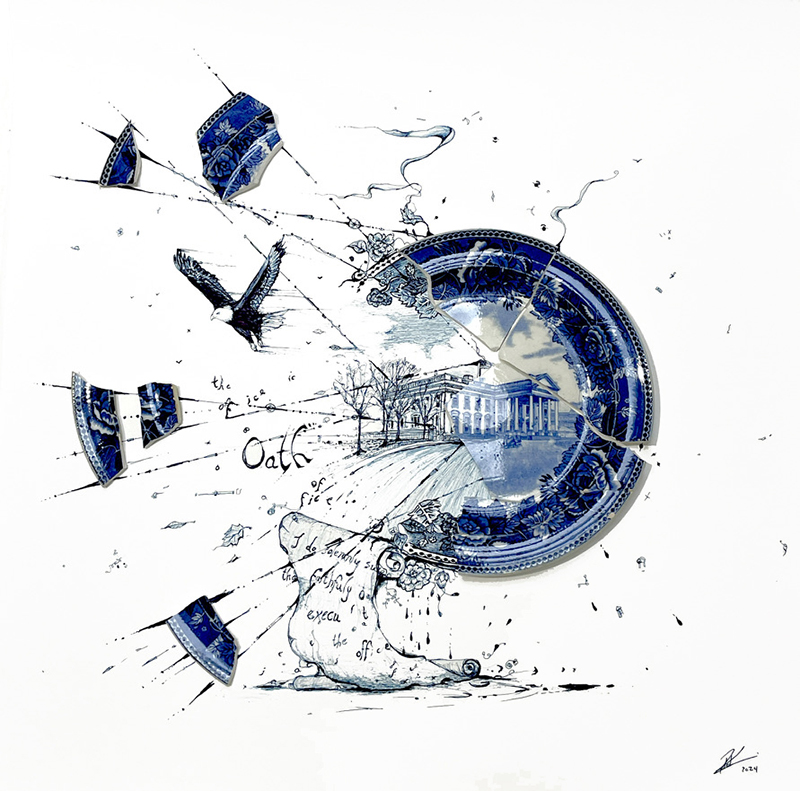
What became known as his Fragmented series has continued to evolve, and now Strati is exploring it through a new body of work called Service. Using broken American porcelain plates and hand-drawn imagery to examine the ideals, contradictions, and rituals that have helped shape the United States, each piece references foundational political language and is priced according to historically significant years, challenging the way we traditionally assign value and exploring value as a political act.
But beneath the references to American history is a question that is much broader than politics: What makes something valuable enough to save? For Strati, the answer is not necessarily its price.
“I think our economic culture is too narrowly focused,” he says. “It looks at a limited number of factors in determining value: scarcity, utility, amount of labor, cost of production, provenance, comparables.”
Those things may help determine what an object is worth on the market. They don’t necessarily account for the memories attached to it.
Consider a plate that has spent 70 years in a family’s home. Its monetary value might be modest, but it may have been present for birthdays, holidays, arguments, celebrations and family meals. It may have belonged to a parent or grandparent and may be one of the few physical objects that connects someone to a particular time in their life. Its history is not printed on a price tag.
“I might be able to buy a plate like that for $15 on eBay,” Strati says. “But when someone sees it and it flashes back all of their memories with family members through the different phases of life…there’s an almost unlimited potential of value.”
That idea is particularly apparent in Service, where even the pricing becomes part of the work, giving each piece another layer of meaning.
The Precedent, for example, is priced at $17,970, referencing 1797, when George Washington relinquished power, ending the presidency after his second term. A More Perfect Union and We the People use $17,760 as their price, referencing 1776 and the nation’s founding while invoking language from the Constitution. The Oath, priced at $20,240, references the 2024 election year and the presidential oath of office.
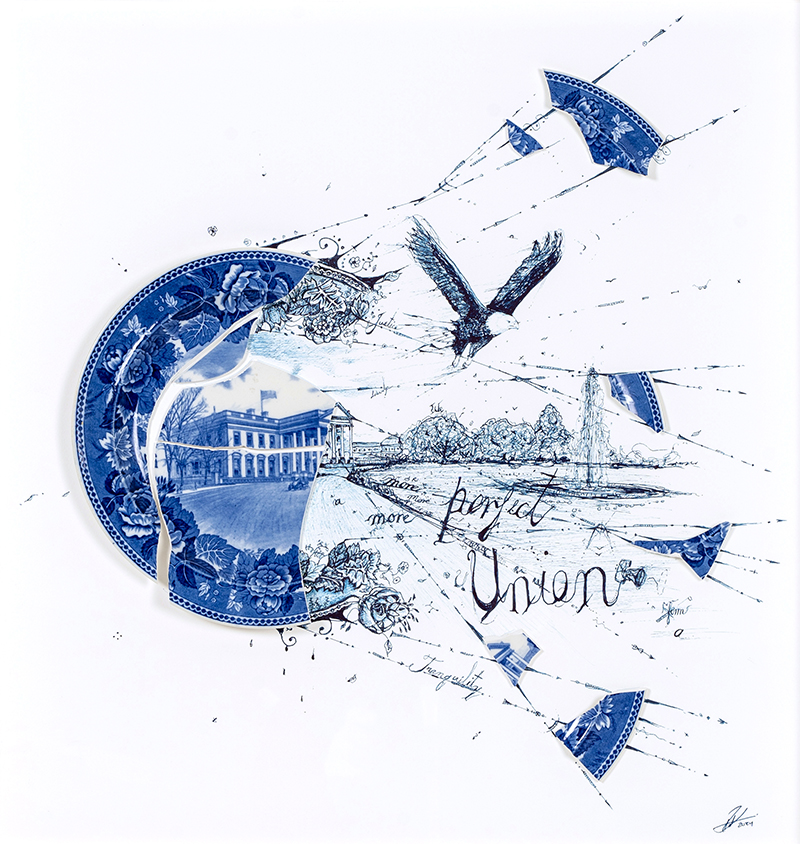
That relationship between an object and the meaning we give it is also what makes Strati’s work an interesting example of upcycling – not simply as an environmentally conscious practice, but as a reconsideration of value.
Upcycling usually means taking something destined to be discarded and turning it into something useful or desirable. Strati pushes the concept further. He asks what happens when the discarded thing is not merely reused but reinterpreted.
The broken plate does not return to its original function. Strati does not repair it so that it can once again sit on a dinner table. Instead, the break becomes part of its new identity.
Strati has seen this firsthand when teaching workshops at museums and schools. People will sometimes approach him afterward to tell him about plates they have broken and say that they now have an idea of what they could do with the pieces instead of throwing them away.
At the Ships of the Sea Maritime Museum in Savannah, he led a workshop using torn pieces of paper with different graphics. What was intended to be a 30-minute exercise stretched toward an hour as participants became absorbed in connecting images that initially appeared unrelated, and were inspired by seeing what other people were creating.
For Strati, there was something important about using material that wasn’t precious.
“There is a combination of fun and freedom, along with a few constraints, that allows people’s imaginations to move in directions they might not otherwise have considered,” he says.
That same idea runs through Service. The broken plate is not valuable because it is intact or rare. Its value comes from what it carries with it — the history of the object, the imagery it contains and the new meaning Strati gives it.
With the United States recently celebrating its 250th anniversary, Strati’s references to American history have an especially timely context. His use of historical dates and language gives the work a particularly relevant context. Rather than presenting a straightforward interpretation of American history, Service reflects on how the ideals of the nation were formed, how they are upheld, and how they fracture over time.
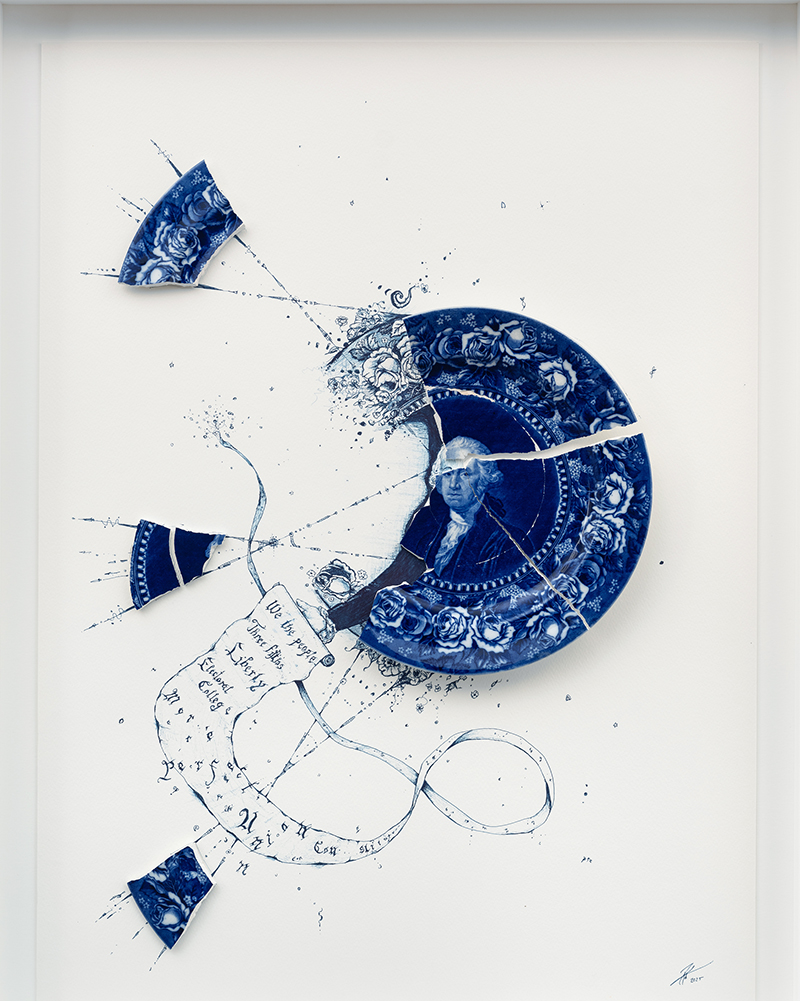
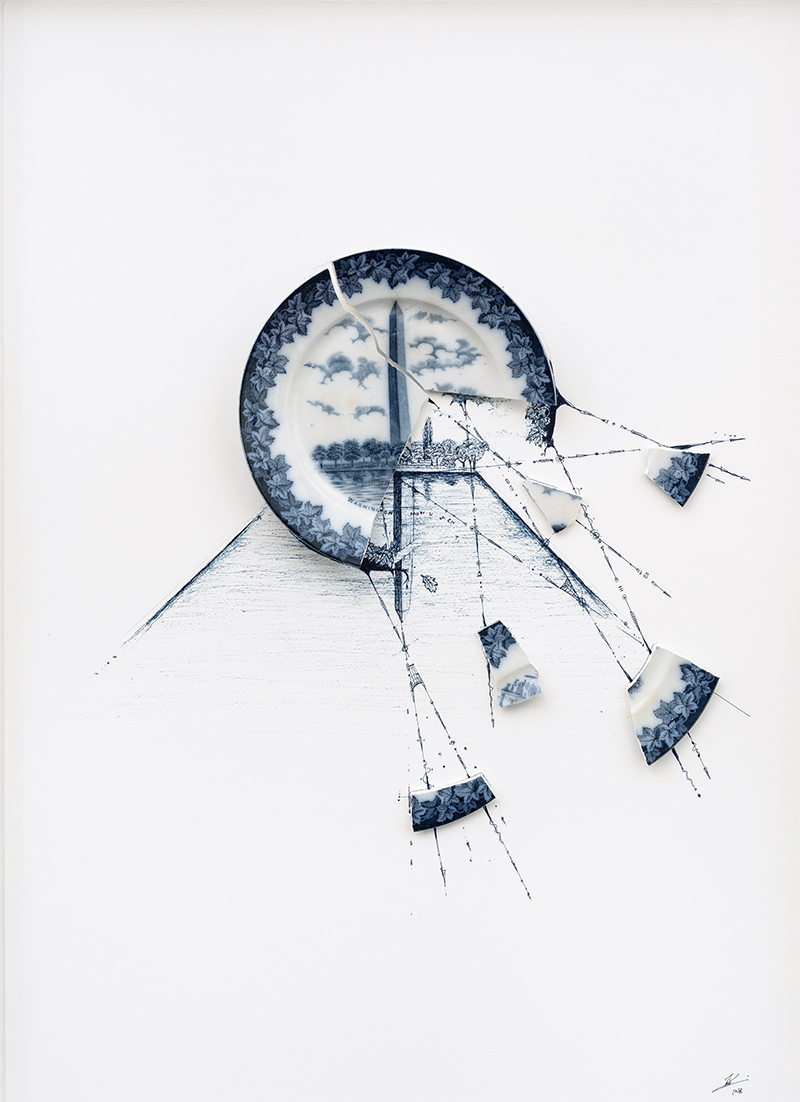
In an era marked by political polarization, institutional distrust, and cultural reckoning, the series offers a material, symbolic meditation on what it means to serve a collective vision of America today, inviting collectors to become part of that ongoing process through their engagement with the work.
Think about it. We assign value to houses, photographs, clothing, furniture and countless other objects because of the stories attached to them. Sometimes those objects are worth very little financially. Sometimes they become priceless to the people who own them.
Strati believes art can help us become more aware of those possibilities. “Art alone does not build a new economic system,” he says. “But it can exercise the imagination that makes alternatives conceivable.”
That may be the most interesting thing about his broken plates. Strati isn’t simply giving discarded objects a second life. He is asking us to reconsider why we decided they were disposable in the first place.
A $15 plate can remain a $15 plate. It can also hold 70 years of family memories. And in Strati’s hands, it can become a work of art worth tens of thousands of dollars.
The difference, Strati suggests, may have less to do with the object itself than with what we are able to see in it.
Learn more about Rob Strati at https://porcelainprojects.com/. Follow him at https://www.instagram.com/robstrati/
Author Bio
Breanna Walther (née Suden) is the founder of Suden PR, a women-owned boutique public relations agency dedicated to helping small businesses, entrepreneurs, and innovative brands gain meaningful media exposure. After years working at top global agencies, Breanna faced a career pivot in 2020 and made the bold decision to launch her own firm. Since then, Suden PR has grown into a powerhouse agency, recognized for its strategic media relations and ability to secure top-tier coverage for clients.
Now headquartered in South Florida, Suden PR continues to serve clients nationally and internationally, offering a strong presence in key media markets. https://www.sudenpr.com/
