
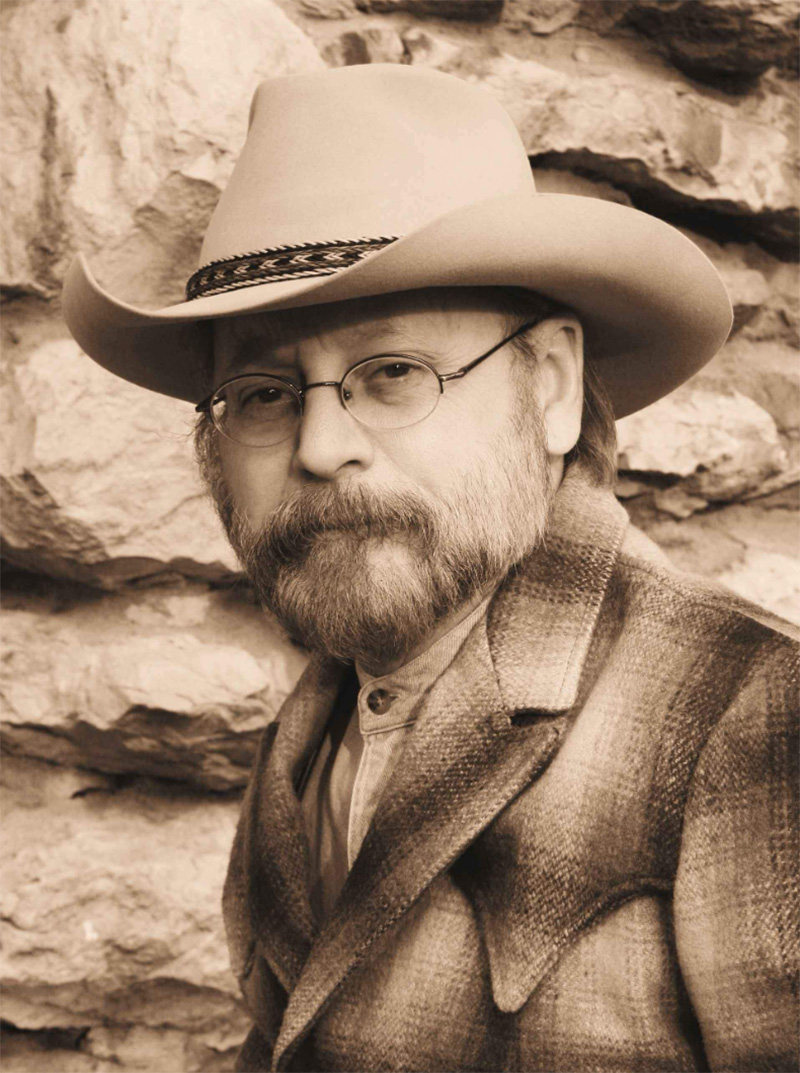
“Since light is the main focus of my paintings, the entire physical world is potential subject matter.” — Marlin Rotach
Some painters chase light. Marlin Rotach captures it in water and holds it fast.
This September, that mastery earns Rotach a place among the fifty artists in the Eiteljorg Museum’s 21st annual Quest for the West, one of the country’s premier Western art shows and sales held at the Museum September 11-13, 2026. He is one of only ten artists invited to make a first-ever appearance at the event, arriving with “Beneath the Azure Sky,” a luminous watercolor that the museum’s vice president for curatorial affairs singled out by name. Behind that invitation sits a quiet argument the market is finally ready to hear that transparent watercolor belongs in the same conversation as oil and bronze.
Sorrel Sky Gallery, which represents Rotach across its Durango, Santa Fe, SoHo, and East Hampton locations, has understood that argument for years. For four decades, Rotach has built a body of work that treats the least forgiving medium in painting as a vehicle for high drama, and collectors who know the field have taken notice. His acceptance into Quest, joining a roster that set an all-time sales record in 2025, is not a debut so much as a wider public confirmation of what his peers already knew.
A Kansas Upbringing, a Lifelong Study of Light
Rotach came to the American West honestly. He was born the son of a commercial artist who also trained stock horses in Kansas, and he grew up among cowboys, horses, billboard layouts, type books, paint, and brushes all at once. That childhood gave him two inheritances at once: a working knowledge of Western life and an early fluency in how images are made. He went on to earn both a BFA and an MFA in painting, then settled in Kansas City, where he keeps his studio.
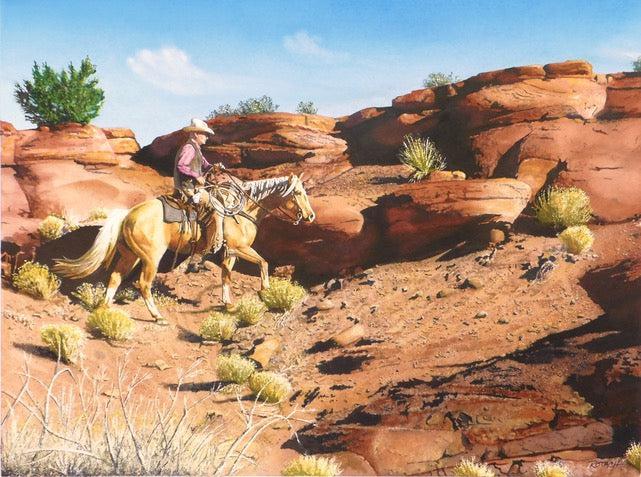
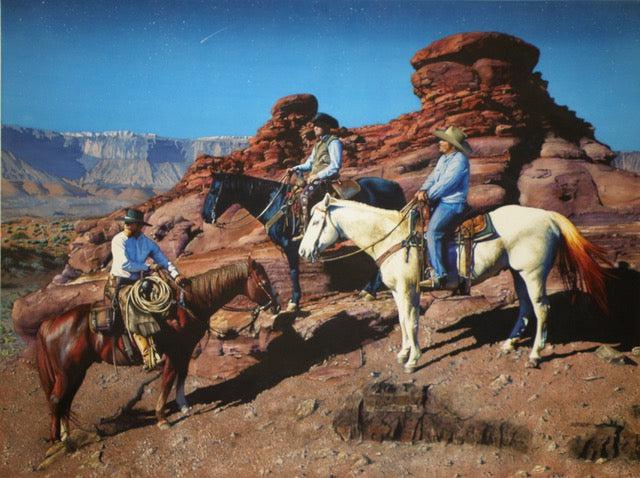
His influences reach far beyond the ranch. Rotach traces his artistic lineage from Caravaggio to Frank Tenney Johnson to Charley Russell, a line of painters bound by one shared obsession: the power of dramatic light and shadow. He carried that obsession into watercolor, where the transparent medium suited his aim exactly. Where other painters build light by adding paint, Rotach builds it by holding paint back, letting the white of the paper itself become the brightest light in the picture.
The Discipline of Transparent Watercolor
Transparent watercolor allows no second chances. Every stroke is permanent, and a lost highlight cannot be repainted. That unforgiving quality is precisely what draws Rotach to it. He plans his highlights before the first wash touches the sheet, thinking in reverse the way a printmaker must, reserving the paper’s brightness from the very beginning.
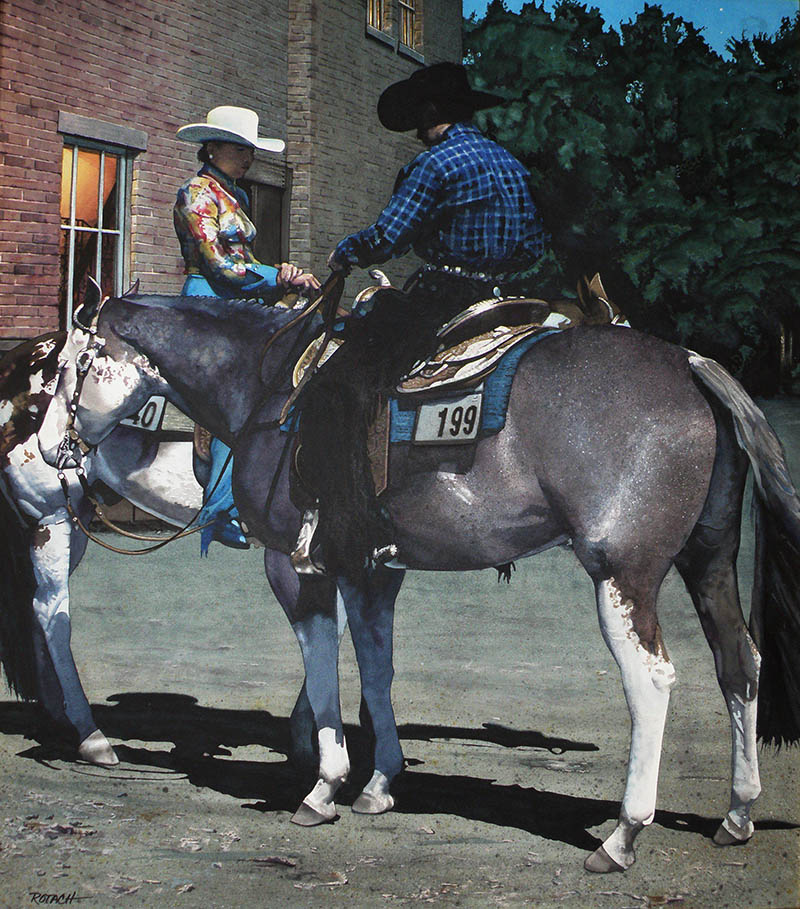
The results reward close looking. In For Spacious Skies, one of his most ambitious recent paintings, the drama lives in what he withholds. Riders of the Red Cliffs turns the same discipline on stone and rider, the pale sandstone glowing precisely because he never painted it at all. In Cow Pony #2, a horse’s sunlit flank carries a charge that oil often struggles to match. And in quieter works such as The Tracker and Moonlit Rendezvous, Rotach lets deep shadow swallow most of the composition so a single shaft of light can carry the entire story.
Rotach’s subjects range widely, from ranch horses and working cowboys to sweeping high country and intimate floral studies, yet light remains his true subject in every one. A blossom in Summer Splendor receives the same rigorous attention to illumination as the open land of For Spacious Skies. For all his technical command, he approaches each painting as a fresh test. “The goal is always to exceed expectations,” he has said. “The work must be ambitious, otherwise what’s the point?” That restlessness keeps a four-decade career from ever settling into formula.
A Résumé Built on Recognition
Rotach’s credentials read like a survey of his field’s highest honors. He holds signature membership in the Transparent Watercolor Society of America, the National Watercolor Society, and the Watercolor U.S.A. Honor Society, with signature standing in nine national watercolor societies in all. His paintings have appeared in more than two hundred exhibitions, and he has taken eleven Best in Show awards among more than twenty honors overall.
The Western establishment has embraced him with warmth. The Cheyenne Frontier Days Rodeo, one of the oldest and largest in the country, chose his painting for its official poster twice, first in 2014 and again for the rodeo’s landmark 125th anniversary, each selection carrying a purchase award and a coveted trophy buckle. The American Royal named him its featured artist. He has been recognized as a Master Painter of the World, and he effectively wrote the book on his subject, authoring a two-hundred-year history of Western watercolor that spans more than forty painters. Southwest Art, Western Art Collector, and International Artist have all carried his work in print. For collectors who read institutional recognition as a market signal, and the serious ones do, Rotach’s file is deep and still growing.
The Collector’s Opportunity
Rotach arrives at a revealing moment. Western watercolor of this caliber has long traded at a discount to oil of comparable stature and provenance, a gap driven far more by convention than by connoisseurship. That gap is narrowing. When a museum sale that moved more than 1.3 million dollars in a single weekend chooses to introduce a watercolorist to its collector base, it signals where informed attention is heading. Rotach is not an emerging name catching that wave. He is an established master whose pricing has not yet fully caught up to his institutional standing, and that lag is exactly the kind of opening that rewards early conviction.
His collection at Sorrel Sky offers meaningful entry points alongside significant statement pieces. Intimate approachably scaled watercolors such as Summer Splendor, MiLady, MiLord, and Basking in the Glory give newer collectors a way in, while major paintings like For Spacious Skies, Team Spirit, and Riders of the Red Cliffs anchor a serious collection. A collector can begin at one level and grow into another, a range that makes Rotach as welcoming to first-time buyers as he is to seasoned patrons.
Scarcity is built into the medium itself. Rotach paints no editions and cannot reproduce a lost passage, which makes every finished watercolor a genuine one-of-a-kind. His sold wall tells that story plainly. Deep Shadows on the Mesa, Court of the Pale Queen, Light of the Lost Canyon, and Elegance in White have already passed into private hands, and works like these do not return.
Light That Holds Still
A Rotach watercolor resists reproduction. The paintings shift as the viewer moves, their reserved highlights catching and releasing light the way a Colorado afternoon does, and no photograph or printed page fully carries that effect. This is work meant to be seen in person, whether in Indianapolis this fall, where Beneath the Azure Sky will hang among the best of contemporary Western art, or on the walls at Sorrel Sky, where paintings such as Exclamation!, Focus, and My First Saddle wait to be discovered.
That is finally the case Marlin Rotach makes, painting after painting. With nothing more than pigment, water, and the nerve to leave the paper alone, he proves that watercolor can hold as much light, drama, and lasting value as any medium in the room.
For more information about Marlin Rotach https://sorrelsky.com/collections/marlin-rotach.
All images are courtesy of Marlin Rotach for Sorrel Sky Gallery. For more information https://sorrelsky.com/.

