
Johannes Vermeer chose to live and paint in the vortex of battle. He witnessed class condescension, and he and his family were the subject of daily religious bigotry and political repression. Why is the academy so timid in seeing the risk and courage and dissent in his paintings?
Once they accepted the “Dutch Golden Age” as the imperative, if not the exclusive, acceptable framework for interpreting Johannes Vermeer’s work, the academy—art historians, academics, the museums (the grandest of them, the Metropolitan Museum of Art, the National Art Gallery, the Frick Collection, the Rijksmuseum)—treated that work as fragile treasures and barely considered Vermeer’s own imperatives. It is as if the powerful awakening to his remarkable skill 300 years after his death could not withstand, despite its now pervasive recognition, even the most obvious questions, and certainly not an acknowledgment that the powerful, at times insidious and dangerous, forces in his life were reflected in the nature, purpose, and subject of his paintings. That failure to recognize his strength of character and purpose has been a disservice to Vermeer’s life and values and to the critique—the dissent, as I have written—that he brought to bear through his work on the immoral conduct and self-centered values of the Dutch Republic. The same conduct and values for which, only recently (2023) and only in part (slavery and colonialism, but not Calvinism and its class condescension), Netherland’s King Willem-Alexander thoughtfully apologized.

In Johannes Vermeer, Provocateur: Risk and Courage in Dissent, I start with this unremarkable reality: “It takes little time for a serious reader and thoughtful explorer in history, geography, and culture to recognize the values on which Dutch colonialism, slavery, and Calvinism actually played out with brutal skill at home and abroad and to realize that the academy’s speculation about Vermeer’s life and paintings has missed the meaning of those forces.”
I am hardly the first to recognize how this reality mattered in Vermeer’s life and painting. In 2006, historian Timothy Brook did so in Vermeer’s Hat. In 2019, McGill University professor Angela Vanhaelen did so by showing how artists in this era did express their critical and personal views through the “art of evasion.” And in 2023, Harvard professor Teju Cole (New York Times Magazine, May 25, 2023) added intellectual muscle to the reconsideration of Vermeer’s work, with an open invitation—a challenge actually—to flush out precisely what he recognized intuitively and empirically. “[T]he world of [his] pictures,” Cole wrote about Vermeer, is “also fractured, vulnerable, isolated, and anxious. His paintings can tolerate more honest context than we often allow them. [They] bring with them both consolation and terror.” That is, Cole sought to frame the reality the academy has resisted.
A fourth force, which thrives on inquisitiveness of reality, comprises the thorough historians of the New Netherland Institute. They and others have voiced with candor about the Dutch Republic’s embrace—at home, on the sea, in the ports of Brazil and western Africa and the Caribbean, in the Hudson Valley, and throughout the Dutch colonies—of the full horror and condescension of slavery. The historians especially note (often with the support of Vermeer’s paintings) the part that Dutch middle-class women, who were trained in ciphering and mathematics, played in ensuring that their families benefited from slavery through their management of purchases, sales, unregulated inheritances, and corrupt business dealings—all while embracing slavery as a domestic symbol of success. The historians also have described what those same women witnessed and supported on their colonial-driven journey to the Americas and during their return to the Netherlands: slaves thrown overboard to ensure that food was available, or disease eradicated. Vermeer captured that mentality and its imperative to elevate and preserve distinction.
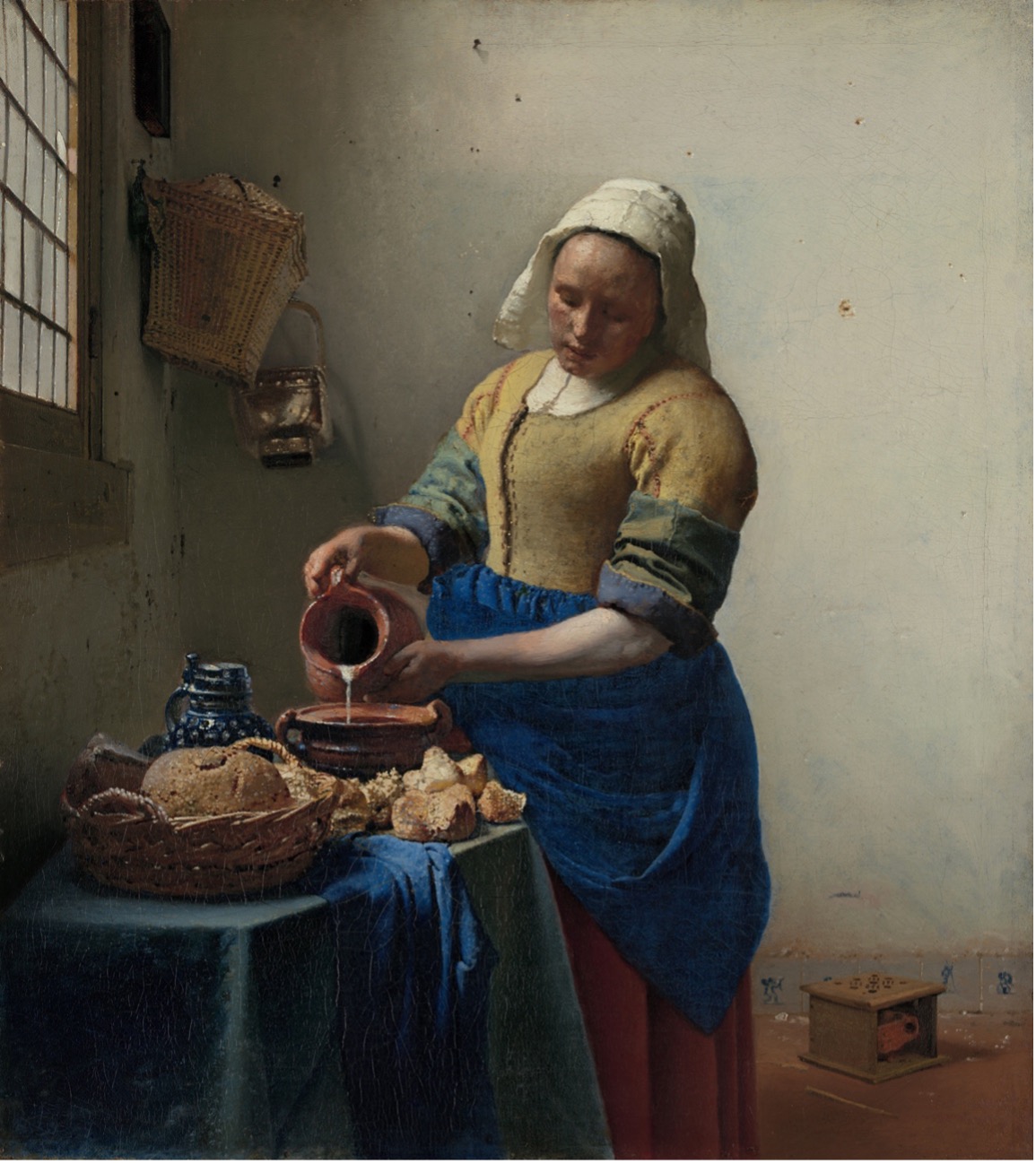
The starting point is not just the 17th-century era or the setting. It is Vermeer, keeping in mind the central personal choices he knowingly made as he reached maturity. The rules were set in Dutch law (i.e., Calvinism was the official religion, only Calvinists could run for public office, the Catholic mass could not be celebrated, and Catholic icons could be—and brutality were—destroyed). The law was enforced with the certainty of earned (during the bitter revolt against Catholic Spain) and righteous condescension and the arbitrary pretext of predestination of the “elect”—what I describe as “who was in, who was out, and who decided it (in reality, not God).” Included among the “out” were non-middle-class Calvinists and, plainly, all Catholics. Look again at The Milkmaid, treated like a serf, poorly paid, and punished at will. Yet, as the public often sees her—as Vermeer elevated and I describe her—“not only as a hard-working commoner but also a dissident, a bulwark with an ethic of determined and confident perseverance . . . within a Dutch society gone terribly astray.”
And within the Dutch Republic (and throughout northern Europe), however discreetly exercised, was the intellectual and skilled force of the Counter-Reformation, the Catholic Church’s determined effort to stop, challenge, and undermine everything Martin Luther, John Calvin, and others had wrought in a battle for governance and wealth, not only souls. From the Council of Trent (1545) onward, art, in all its forms, was a poignant means of advocacy. The Dutch had transformed its power into law. Despite, for example, the sentiment affixed to Vermeer’s paintings in a later era, there are no soft, tender feelings of “love” or “love letters” in Vermeer’s portrayal of women. Calvinism—and the Roman and Greek meaning of “love” in the 17th century—bore no relationship to the 20th-century western definition embraced by the academy that neutered Vermeer’s imperative.
The choices Johannes Vermeer made were:
- To convert from his birth family’s committed Calvinism—affirmed in the war against Spain—to his own Catholicism
- To live in the home of his cunningly devoted Catholic mother-in-law, Maria Thins
- To live in the De Paepenhoek (Papists’ Corner)—characterized by historian and artist Jonathan Janson as the Catholic “ghetto”—a few feet from the once Catholic New Church, which, stripped by force of its icons and repainted wholly white, remains readily visible then and now as the Calvinist New Church
- To live next to the Jesuit Station, where the Catholic mass was held clandestinely, his 11 children were taught, and he was educated in the manner of painting biblical and religious moments
- To accept that all such education and risk-taking was led by the Jesuit Catholic order designated by the Pope to lead the Counter-Reformation, as teachers and, critically, as advocates against power, authority, culture, and the legally sanctioned Calvinist religion of the Dutch Republic
Vermeer made these choices as a parent, husband, trained artist, and small and vulnerable business owner trading in other people’s artworks.
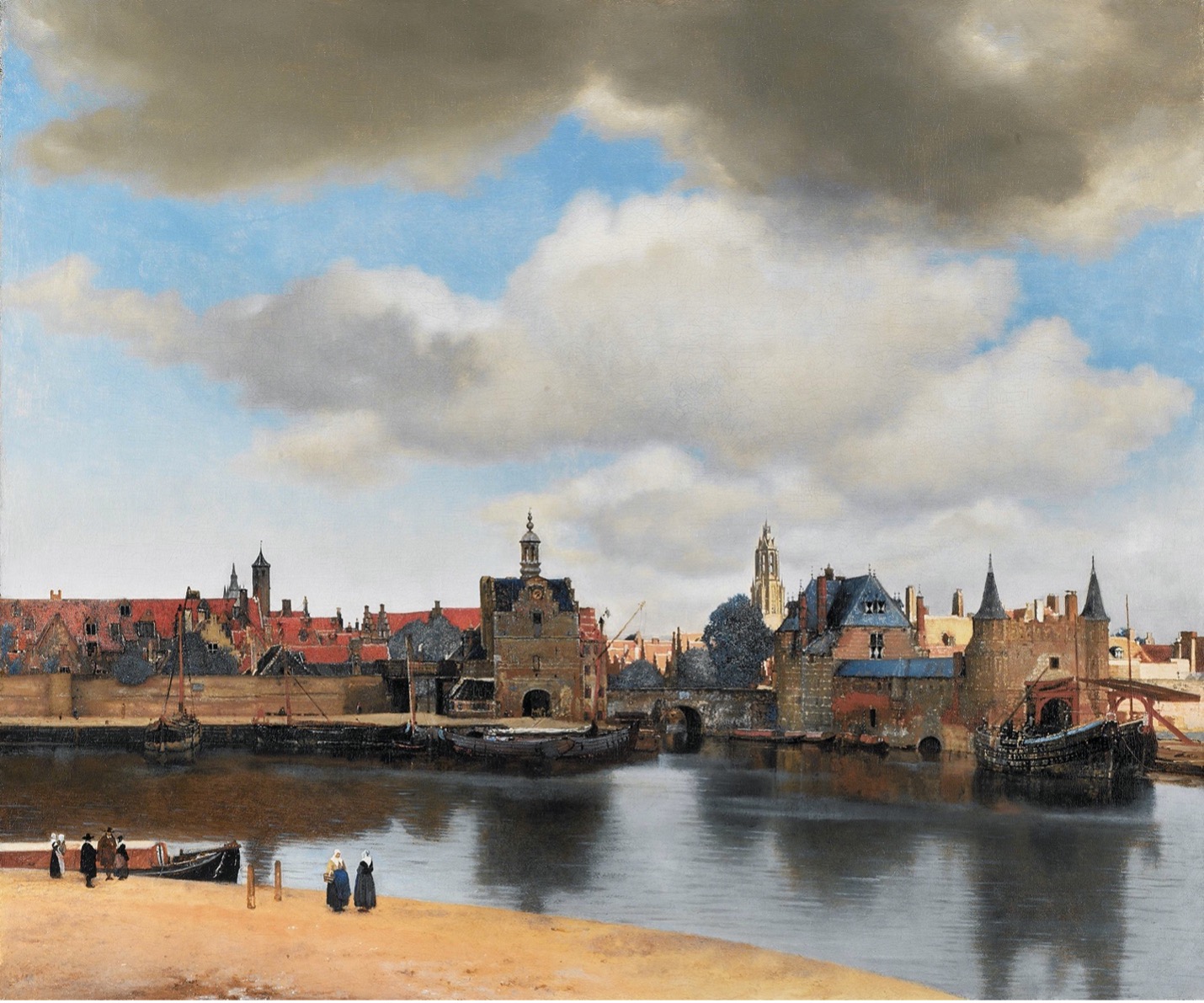
Another massive force exercised its own widely accepted law with impunity: the globally powerful Dutch East India Company (VOC) and Dutch West India Company (WIC). Their primary imperative: dominating geographic settings through warfare in Asia, Africa, and the Americas. Enforcing Dutch colonization abetted by slavery in all of those areas, as visibly practiced through ownership and pride within the Dutch Republic by a thriving middle class—led and exploited by women. The VOC still stands today in Delft, its emblem plain and preserved. Its importance to Vermeer in his own battle—as historian Timothy Brook recognized and I witnessed—is fully portrayed in View of Delft.
War, with Catholic France and with England, returned to the Dutch Republic in 1672, a few years before Vermeer’s death. That war ended the prospect that Vermeer’s work would be recognized and shared much earlier than it was. Today, civic leaders and volunteers in Delft, and those within the academy devoted to creating the life of Johannes Vermeer, immediately bootstrapped him with fragility and for generations into the mythological “Dutch Golden Age.” What is certain from the outset of his mature life—and what is reflected in his paintings—is that Vermeer made battle-tempered personal choices within a horrific time and setting. He placed himself in its center. In its vortex. And, with those choices and that setting in mind, Vermeer exercised risk and courage in dissent. And he was likely not alone.
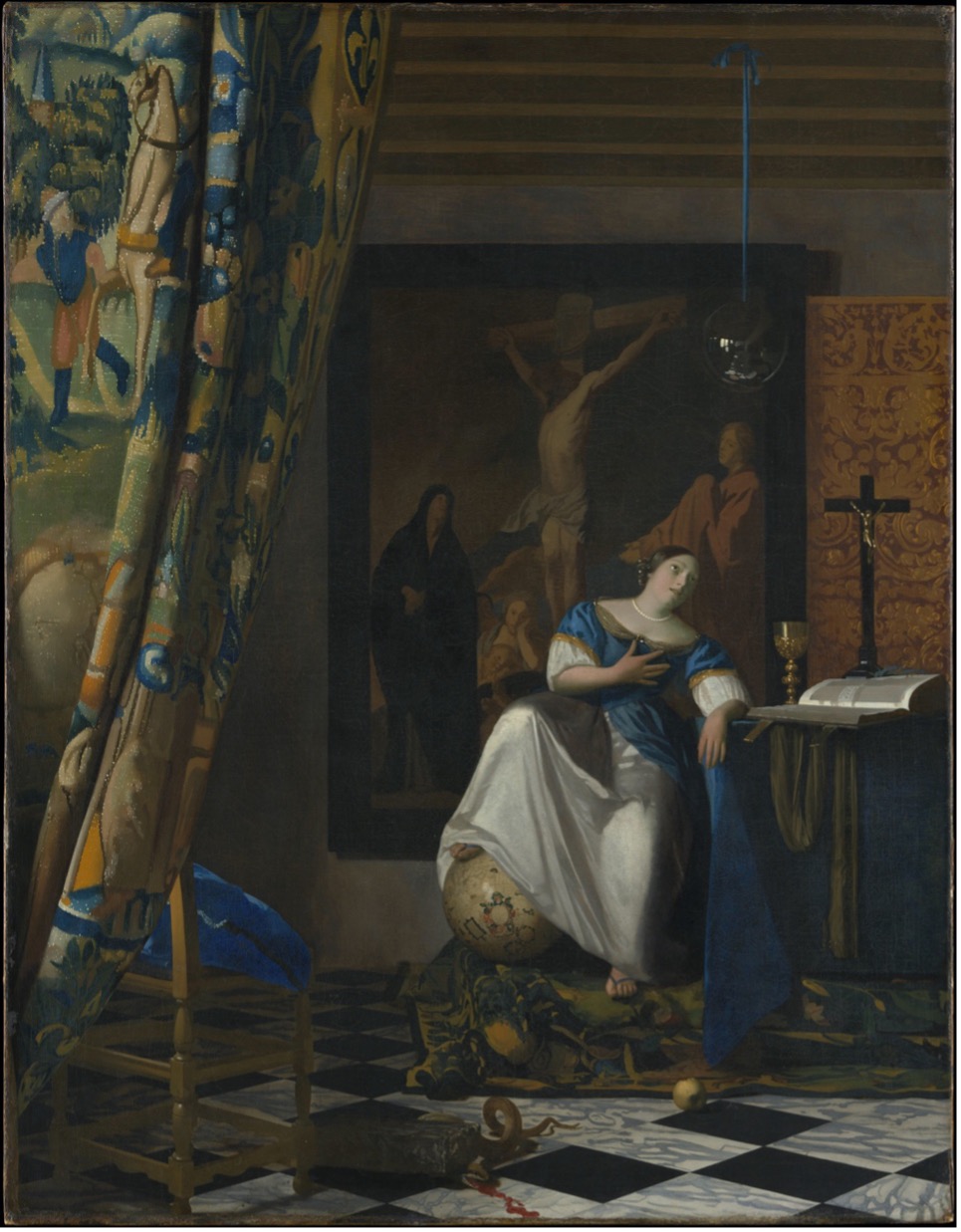
Look at his paintings again, with that setting, those forces, and Vermeer’s choices in mind. Start with every middle-class woman writing, reading, or receiving a letter or holding a balance with her measured wealth visible or admired. Notice her cocky certainty. Look as well at Allegory of the Catholic Faith, not only as remarkable art but as risk-taking against Calvinism in Vermeer’s battle for citizenship.

