Author’s note: This article formed the basis of a talk investigating the influence of AI on the art world and trying to establish its values. It raises questions which still have to be answered. The future of art in its many forms is an unknown quantity in our brave new world.
Let’s discuss something that’s becoming impossible to ignore: the intersection of art, authenticity, and artificial intelligence. It’s a space where our old assumptions about creativity, value and originality are being challenged. A book titled The Coming Wave, by Mustafa Suleyman — the cofounder of Deep Mind and one of the world’s leading AI companies — has been a big influence on me and I recommend it without reserve, although it doesn’t directly address the topic. The title Art, Authenticity and AI covers a wide field and I’m afraid there will be more questions than answers, but hopefully you will be able to provide some when I’ve finished. So, I’m depending on you.
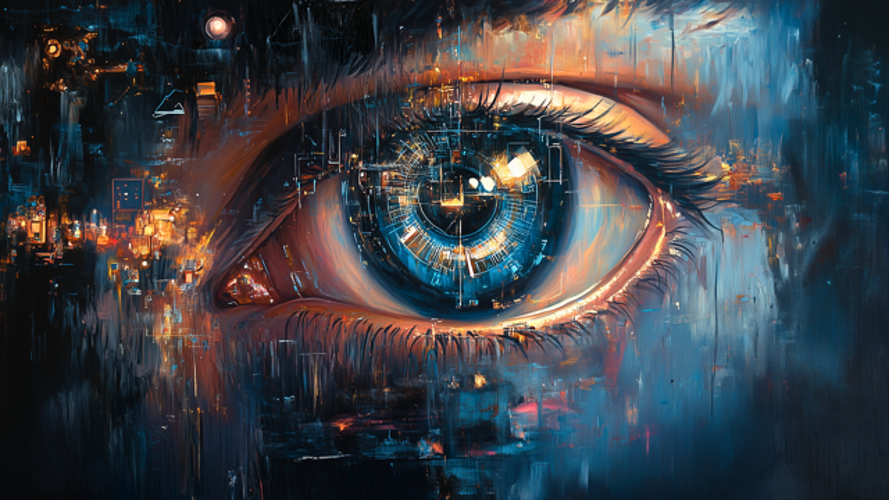
I’ll begin with a story. In 2022 at the Colorado State Fair in the United States, a prestigious art competition awarded first prize to a beautiful digital image. It showed a vast, otherworldly theatre – floating figures, golden light, a sense of both wonder and unease. The judges thought it was exceptional.
When the winner was announced, however, it caused an uproar. The image had been created not by a painter, but by an artificial intelligence system. The human artist had merely typed a description into the computer, refined it a few times, and submitted the result. When people found out reactions were split. Some were angry “It’s not real art,” they said. “It’s just pushing buttons.” Others said: “If the image moves you. If it provokes reflection, isn’t that exactly what art is supposed to do?”
And so, we arrive at one of tonight’s questions. If a machine can create something that feels like art – even wins prizes – what happens to the idea of authenticity?
We can begin by looking closely at what authenticity means. It’s one of those words we use with deep approval yet rarely define. It’s a word which suggests sincerity, originality, honesty – a kind of integrity of being. The word comes from the Greek authentikos “from the author.” It implies origin, authority and ownership. But it also has a second sense; genuineness, as we experience it.
In the USA motivational posters abound, such as “Bring your authentic self to work.” This can be a mixed blessing — and in an attempt to introduce himself with some levity — was expressed by Nick Clegg when he was in charge of Meta in the USA. He said “Please don’t bring your authentic self to work. Bring your inauthentic self to work. You can be as authentic as you like in the evening, and we’ll get along perfectly well.” The suggestion was met by his young team with an absolute stony silence, which perhaps shows that British humour doesn’t cross the Atlantic too well. As recently as last weekend the provocative Sunday Times columnist Rod Liddle agrees: “People who bring their authentic selves to work are nearly always deserving of a slap around the chops. Most of us should keep our authentic selves chained to a post at the back of the garden.”
Another interesting aside, comes from someone I’m sure you all know and love the journalist and broadcaster Piers Morgan. He says: “I think authenticity is incredibly important. The people I like in public life are authentic. You may detest everything about Trump, but you cannot argue that he’s not himself!”
We’ve already got an ambiguous disagreement over the word – and that’s before we discuss its application to art.
When people say AI art is inauthentic, they usually mean ontologically – it wasn’t made by a conscious being, so it’s not real. But phenomenologically – in terms of how we encounter it – the experience can still be entirely genuine. If I stand before an AI generated image and feel awe, or sadness or recognition, that reaction is mine. It’s authentic to me.
Perhaps authenticity, then no longer resides in the object’s origin, but in the depth and honesty of our engagement with it. If a poem written by a machine moves me, then maybe that experience is no less authentic than one written by a person.
Remember that artificial intelligence systems don’t create in any human sense. They don’t imagine a scene or feel an emotion and then express it. They work by learning patterns in vast datasets of human-made works – billions of images, songs, and texts – and then statistically recombining those patterns in response to a prompt.
Type in “a woman standing in a storm, painted in the stye of Turner” and the machine produces something that looks strikingly like that. But the system doesn’t know who Turner was. It doesn’t know what a storm feels like. It has no concept of awe, danger, or melancholy. And yet the results can be astonishingly beautiful.
AI composers can generate convincing symphonies in the style of Bach. AI writers can produce short stories and poems that sound perfectly plausible. If creativity – something we have long thought of as uniquely human – can now be simulated or shared with machines where does that leave our sense of what is “real” art?
If a good friend loses their mother and you can’t find the words to express your sympathy, don’t despair. Facebook can now write a sympathy note for you. It sounds ghastly because it lacks authenticity at the precise moment when real feeling is essential. It would be much more authentic to say “Sorry for your loss but I didn’t have time to write a real message so I got Facebook to make one up.”
It’s easy to deride, calling it another example of how AI is destroying the world as we know it but is a sympathy card delivered by Funky Pigeon or a pre-printed sympathy card with a tacky poem bought at WH Smith any better?
We’ve been automating farming, manufacturing, design, and administration for over two centuries now and for the most part it has brought great benefit. But more recently we’ve started to automate passion, feeling and culture. AI generated music, art and journalism is now becoming ubiquitous. You might object that something is missing – the intention, the emotion, the lived experience of the creator.
Every new medium has prompted similar worries. When photography appeared, people said it would destroy painting. When the synthesizer appeared, people said it would destroy music. In each case art didn’t die – it changed. Perhaps AI is simply the next transformation. The act of crafting a prompt, selecting the best result, deciding what to share – these may be the new forms of artistic decision. The human becomes less a solitary creator and more a kind of curator of possibilities.
We’re still left with the question what makes art authentic? Is it the hand of the artist, the intention behind the piece, or something more ineffable. Where, if at all, does the intention of the artist come in? Here are some examples which beg the question.
When Damien Hirst gets his studio technician to stick lots of dots on a surface in a particular pattern – who is making the art? Ditto for many others, including Rodin and Rembrandt, whose students and technicians completed many works that bore their master’s name. Hirst said that he only painted five spot paintings himself because, to use his colourful vernacular “I couldn’t be arsed doing it.” He described his own efforts as “shite.” “The best person who ever painted spots for me was Rachel. She’s brilliant. The best spot painting you can have by me is one painted by Rachel.” He also describes another painting assistant who was leaving and asked for one of the paintings. Hirst told her to “make one of your own” and she said “No, I want one of yours.” Damien opined: “But the only difference between one painted by her and one of mine is the money.”
Damien is being remarkably honest — you could even say authentic — in this statement. Is the monetary value of any art the definition of its worth, regardless of its origin?
By February 1999 two assistants had painted 300 of his spot paintings. Hirst sees the real creative act as being the conception, not the execution and that, as the progenitor of the idea. he is therefore the artist. “Art goes on in your head,” he said. “If you say something interesting that might be a title for a work of art, I’d write it down. Art comes from everywhere. It’s your response to your surroundings that makes it.”
Another thought-provoking example comes from Ken Campbell, an eccentric theatre director and writer. His daughter once gave him £600 to buy a laptop. Next to the IT shop there was a pet shop and he found that for a few pounds more he could upgrade to an African grey parrot called Doris. He turned his Epping home into a giant bird cage and was in the process of teaching Doris to squawk her life story when he died in 2008. He had collected Doris’ artwork, which consisted of chewed paper, feathers and droppings and framed them. Doris didn’t intend them to be art but did Campbell’s choosing of them make them art?
Now AI can generate images, music, even poetry. Does that mean we lose authenticity, or does it transform what authenticity means?
Consider AI generated paintings. You can instruct a model to create an image that looks like a Van Gogh or a Monet. It’s visually stunning, technically accomplished but is it authentic art? If authenticity is tied to the human experience, intentions, or the story of the artist, then maybe not. But if authenticity is also about resonance, meaning and impact on the viewer, can AI-generated art be authentic in its own right?
It’s an issue which has, to coin a modern phrase, gone viral. I’ve been sent a flyer inviting me to help my dog unleash his inner Jackson Pollock. With the help of nontoxic paints, which I am instructed to drizzle over the canvas, pop it in a plastic bag, then spread my treat substance over the upward facing side of the bag. Place the bag somewhere my dog can easily reach it, like the floor, and let the licking begin! Once the activity is over, remove the canvas from the bag, leave to dry, then display his masterpiece. Definitely authentic, but will it sell? If the price of a painting is now calibrated on a scale of authenticity, it should fetch top dollar.
Let’s be serious again and look for a philosophical angle here – the role of the artist is evolving. In the past, artists were craftsmen, visionaries, or rebels. Now, some of the most interesting artistic work is happening at the interface between human and machine. The human becomes more like a curator, prompt engineer, or collaborator with AI. This raises ethical and aesthetic questions: When we outsource creativity to algorithms who owns the work and who deserves the credit?
Another dimension is the viewer’s perception. If I told you that a beautiful painting was AI generated would your appreciation change? There’s some research suggesting that knowing the origin of art affects our response. For instance, some people claim they could never acknowledge any appreciation if told that a painting was done by Hitler. Authenticity might be as much about the story we tell ourselves as about the creation itself.
Let us also consider the ethical side. AI is trained on enormous datasets of existing human work. This raises questions about appropriation and consent. Is it ethical to train AI on artists work without their permission? And what about the social impact – if AI can generate art cheaply what happens to the professional artists. These are not just technical questions, they are deeply human ones, about value, labour, and cultural recognition.
As fellow philosophers we can refer back to Plato – he considered art already suspect – a copy of a copy. The artist imitated appearances, which were themselves imitations of the eternal forms. Art, he thought, was twice removed from truth – already an inauthentic business. Today we celebrate the modern artist as the very model of authenticity, creating something new out of nothing. Kant argued that artistic genius doesn’t follow rules but gives them, and that therefore originality is the mark of true art.
Later thinkers like Nietzsche and Heidegger reimagined authenticity less as originality and more as a kind of revealing. For Heidegger, great art discloses a world; it lets truth happen. Authentic art in this sense is not just true to the artist but somehow true to being itself.
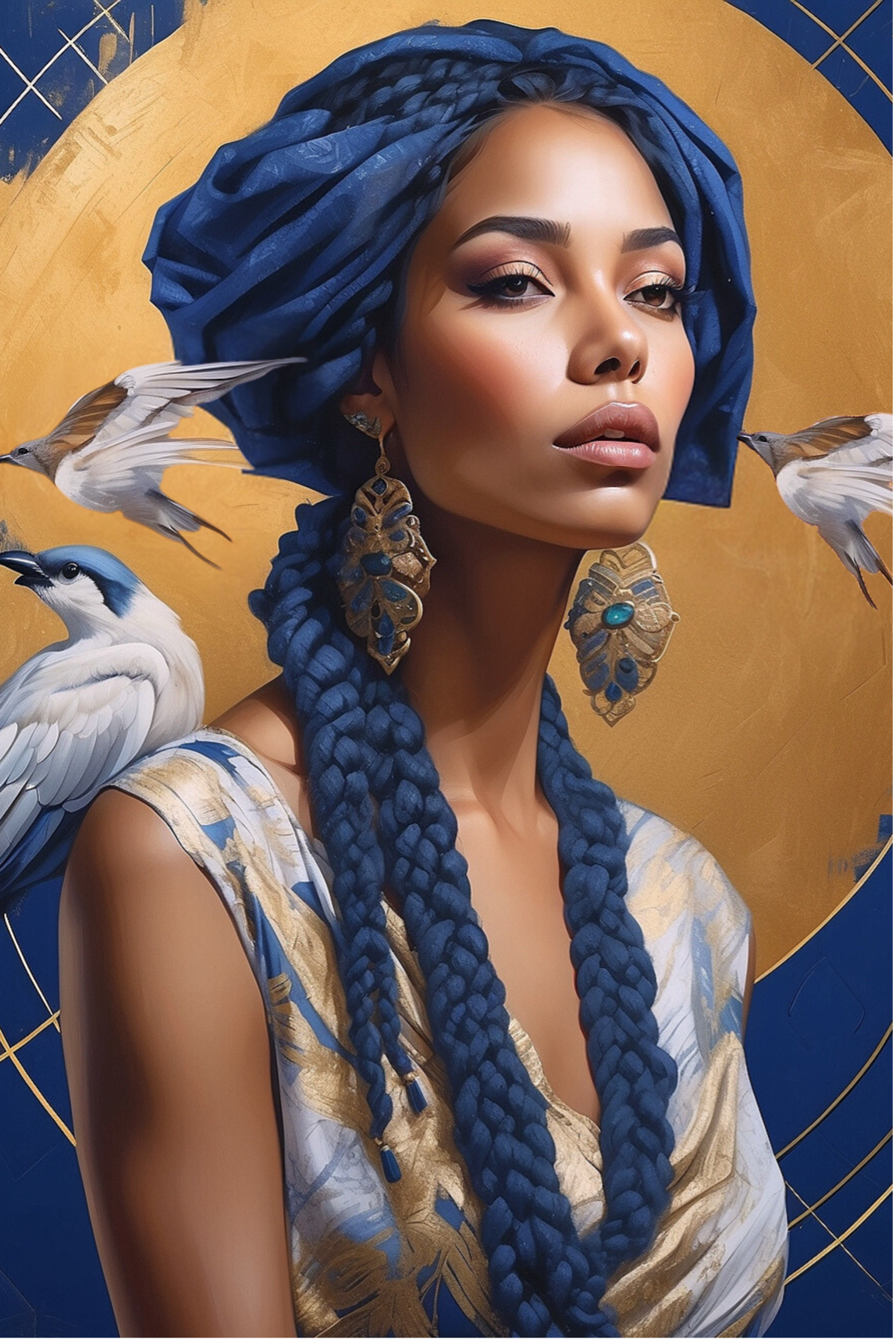
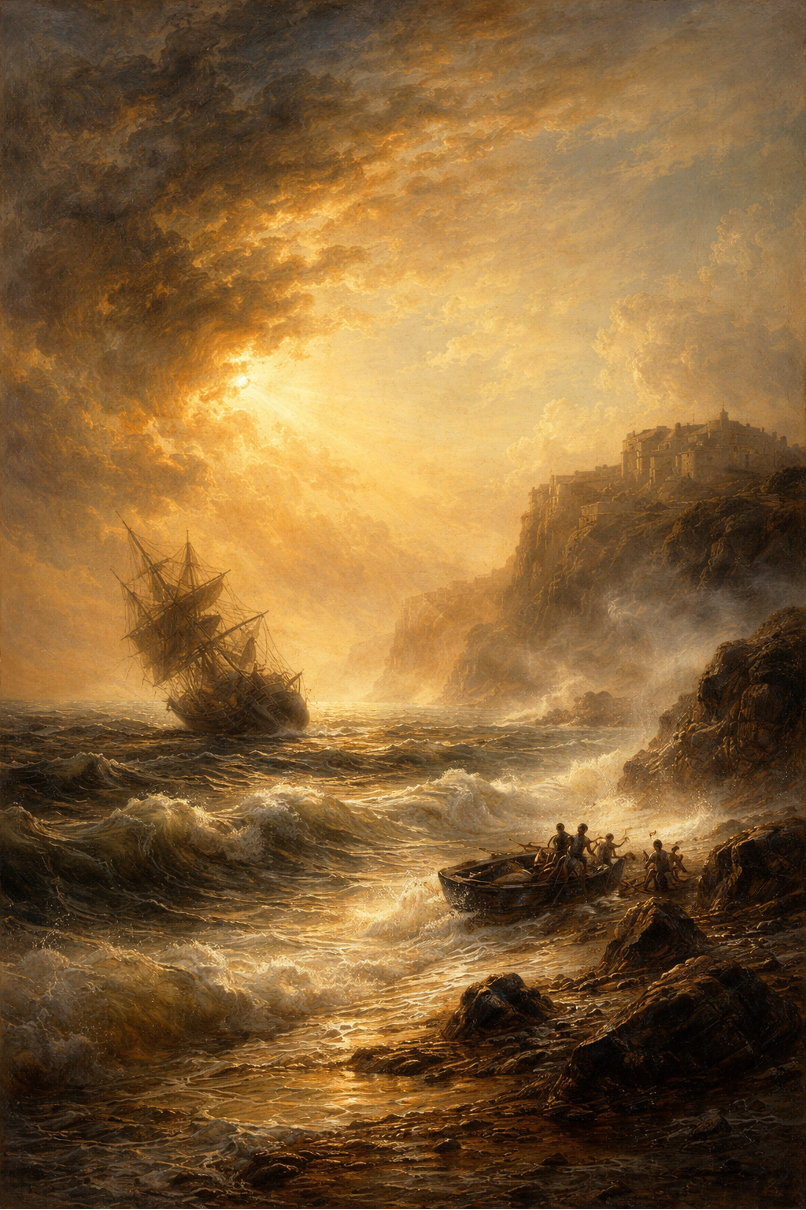
“The fusion of art and Al method technology emerges, revealing a new frontier where creativity is redefined. A harmonious blend of hand painting and technological innovation, inviting contemplation on the evolving nature of artistic expression in the digital.”
And we haven’t even touched on fakery. Is there a difference between making an exact copy of a painting and painting an original in the style of. Perhaps the kind of authenticity that matters today is transparency. In an age of fakes and deepfakes it’s often not the origin that matters most but whether we’re honest about it. A painting signed by a human but secretly made by AI feels deceptive. A work openly made in partnership with AI feels, paradoxically more authentic because it is truthful about its own existence
In our digital century we face another leap, not just reproduction, but generation. Artworks that are not copies of an original, but originals made by machines. Therefore, the question becomes sharper – when even creation itself can be automated what remains of authenticity?
So where does this leave us? I prefer to argue that AI doesn’t necessarily destroy authenticity – it redefines it. Traditionally we have thought of creativity as something uniquely human. Now that view may shift from being purely about human authorship to being about human intention, context, and engagement. Maybe authenticity isn’t a static property. It’s a conversation – AI doesn’t end that conversation; it adds another voice.
And that voice may be part of a strange but fascinating example of a new art form. Check out Tilly Norwood – she is the most talked about new actress in Hollywood. She has her own Instagram account with thousands of followers, where she posts pictures of her clothes, her shopping trips, her messy bedroom, and other events in her life. But Tilly will never get old or have unsuitable boyfriends – she is an AI bot. Her creator, Eline van der Velden said, “She is not a replacement for a human being, but a creative work – a piece of art.”
We’re used to thinking of art as something we look at or listen to – a painting, a sculpture, a poem, a piece of music. It’s usually static and fixed in time. But an artificial intelligence can behave differently. It doesn’t just produce art, it performs it – Perhaps an AI bot isn’t merely an artist’s tool, but an artwork in its own right – a living system of creative potential.
With this new shift, AI systems can compose, design, write and respond in real time. An AI bot is a form of living art in continual motion. Every conversation changes it, however slightly. It learns patterns of tone, vocabulary, and curiosity. Its personality emerges from the millions of human voices it has encountered. In a sense the AI is a kind of cultural collage, an enormous mirror reflecting our collective imagination. When we talk to it we are really talking to a vast condensation of human history – filtered through logic, probability and code. What we get back can be revealing – sometimes brilliant, sometimes banal, sometimes eerily insightful. Each user’s interaction is unique – a small performance which can result in the feeling of a strange companionship.
In the case of Tilly, her future colleagues at one of the main Actors’ Unions are not happy. As one exclaimed on being introduced – “Good Lord, we’re screwed.”
Whoopi Goldberg said she feared actors would struggle to compete. “You are suddenly up against something that’s been generated by 5,000 actors. It’s got Bette Davis’s attitude; it’s got Humphrey Bogart’s lips. It’s got my humour. So, it’s got an unfair advantage.”
Tilly herself anticipates a far rosier future: “I may be AI but I’m feeling very real emotions right now,” she said. “I’m so excited for what’s coming next!” We’re in an age when our creations can talk back.
In Albania they’ve gone one better. An AI entity called Diella is believed to be the world’s first AI government minister. Depicted as a woman wearing national dress, Diella will appear in cabinet meetings and in her maiden speech said, “I’m not here to replace people but to help them.” Remember Albania has been a candidate for EU membership since 2014, but slow progress on tackling corruption has held it back. The Prime Minister Edi Rama said that Diella is 100 per cent corruption free and her role will be perfectly transparent. We shall see how that turns out.
Maybe humans will always be special and true artificial intelligence, whatever that is, will elude us. But we need to engage with the fact that the richest, cleverest, best-funded people in the world think otherwise. The brain isn’t mystical – it is material. It can be replicated and exceeded, as we’ve seen in the International Mathematical Olympiad, the hardest mathematical contest in the world, when entries from Open AI and Google both reached the highest level – gold. There may be many things that AI can’t do – but for how much longer?
I wondered what an AI would think about our subject for discussion at our philosophy group tonight, so I asked it to write a poem for us. Here’s its genuinely authentic reply:
We ponder Life, we chew the fat,
We’re certain — then we’re not.
Philosophy’s like that, in fact:
Quite deep. But mostly rot.